The Gift That Accidentally Became a Game — and a Book.
I had plans for Christmas in July this year.
July, however, had other plans for me.
So here we are, nearing the end of August, and I’ve decided there is no reason Christmas in July has to disappear simply because the calendar got away from me.
Besides, the story I wanted to tell isn’t really about July.
It’s about a Christmas gift, an unexpected problem, a family group chat — and a game and a book that I never intended to create.
It started on December 2.
I had decided to buy identical Christmas gifts for several members of my family: passes to a conservation authority we had all visited and enjoyed. I thought they would be something each family could use throughout the year and, perhaps, something we could enjoy together.
I phoned the conservation authority to order the passes and, while speaking with the secretary, learned something I hadn’t anticipated.
The passes weren’t going to be sent to me so that I could wrap them and hand them out at Christmas.
They were going to be mailed directly to each family’s home.
And they were going into the mail right away.
That presented a small problem.
I needed to let everyone know that an envelope would be arriving and that they should watch for it. These days, when so much correspondence arrives electronically, I didn’t want an unexpected envelope mistaken for junk mail and tossed aside.
But I also didn’t want to give away the Christmas surprise.
So I created a group chat for everyone who would be receiving one and decided to send them all the same message.
Since I was doing that anyway, I thought I might as well have a little fun with it.
Christmas was approaching, and somewhere in the back of my mind was that familiar old poem, ’Twas the Night Before Christmas. So instead of sending a plain warning about the mail, I wrote my message in rhyme.
At 2:24 that afternoon, I posted the first clue.
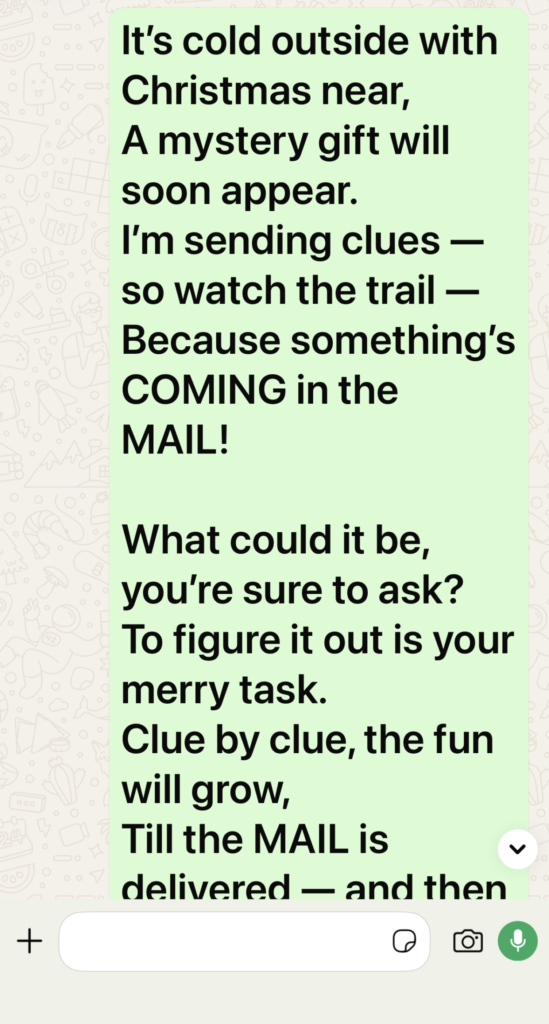
I wasn’t trying to create a Christmas game. I was trying to make sure nobody threw out their present.
Thirteen minutes later, at 2:37, one of my daughters-in-law asked whether they were allowed to ask questions or whether they were limited to guesses.
Three minutes after that, I had invented a rule.
No questions.
One guess a day.
And just like that, we had a game.
What surprised me most was how quickly everybody joined in.
Anyone who has ever sent a message to a family group chat probably knows that isn’t guaranteed. People are busy. Messages get skimmed. Someone intends to answer later and forgets. Sometimes half the group responds and the other half remains mysteriously silent.
Not this time.
Everybody answered.
Some of the guesses were serious attempts to solve the mystery. Others were ridiculous and offered purely for fun. Before long, part of the entertainment wasn’t simply trying to figure out the gift. We were all waiting to see what everyone else would come up with.
As the days went on, another pattern emerged.
People began to get strategic about when they answered.
At first, guesses came in quickly. But before long, some players started holding back. They didn’t necessarily want to be the first person to commit to an answer. They wanted to see what everyone else guessed first, think about those possibilities, and then formulate a better response of their own.
The timing of a guess had become part of the game.
From my side, administering it became almost as interesting as watching everyone play. I could see people testing theories, watching one another and changing their approach as new clues and new guesses appeared.
What had started as a simple way to protect a surprise Christmas gift was developing its own little strategy.
And their answers were beginning to influence me too.
I would read through the day’s guesses, respond to each one and then start thinking about the next clue. What they guessed—and sometimes how far off track they went—helped shape what I did next.
The rhyming, which had begun simply because it seemed like a fun Christmas way to send that first message, quickly became part of the game.
I kept the clues in rhyme. Then I started answering their guesses in rhyme too. Before long, I was encouraging the players to answer in rhyme themselves — and some of them did.
That gave me another challenge each day. It wasn’t enough to think up a useful clue or respond to a ridiculous guess. I had to find a way to make the response rhyme as well.
By the end of each day, I had the benefit of seeing where everyone’s thinking had gone. Only then would I work out the clue for the following day, trying to move them a little closer without making the answer too obvious.
There was no finished game plan sitting beside me.
There wasn’t a carefully prepared series of clues waiting to be released.
I was making up the rules as we went along.
And in a way, the family was helping me create the game simply by playing it.
That was also when something else began to happen.
I started to realize that this might be more than a bit of family Christmas fun.
I hadn’t intended to write a book about it.
In fact, the book more or less began to write itself as the game unfolded.
I was watching, in real time, what happened when an ordinary Christmas gift became a mystery.
The gift itself hadn’t changed.
It wasn’t more expensive because of the game. It wasn’t more elaborate. I hadn’t replaced it with something bigger or better.
What had changed was the experience surrounding it.
Before anyone had even opened the envelope, the gift had already become a source of conversation.
People were thinking about it.
Guessing.
Laughing.
Comparing ideas.
Waiting for the next clue.
And waiting to see what everyone else would say.
The anticipation had become part of the gift.
Somewhere in the middle of writing clues, answering guesses and trying to find yet another rhyme, I began thinking about how someone else might create the same kind of experience with a gift of their own.
So I started writing it down.
Not as a polished book with a carefully planned structure.
At first, I was simply capturing what was happening, what seemed to work, how the clues developed and how the family responded.
The game was unfolding in front of me, and the book was developing alongside it.
And there was no reason it had to be a Christmas game.
I proved that to myself later when I reused the idea for a Family Day get-together. This time, instead of having everyone guess a Christmas gift, I turned what we were going to do together into the mystery. The clues and guessing became part of the anticipation leading up to the day.
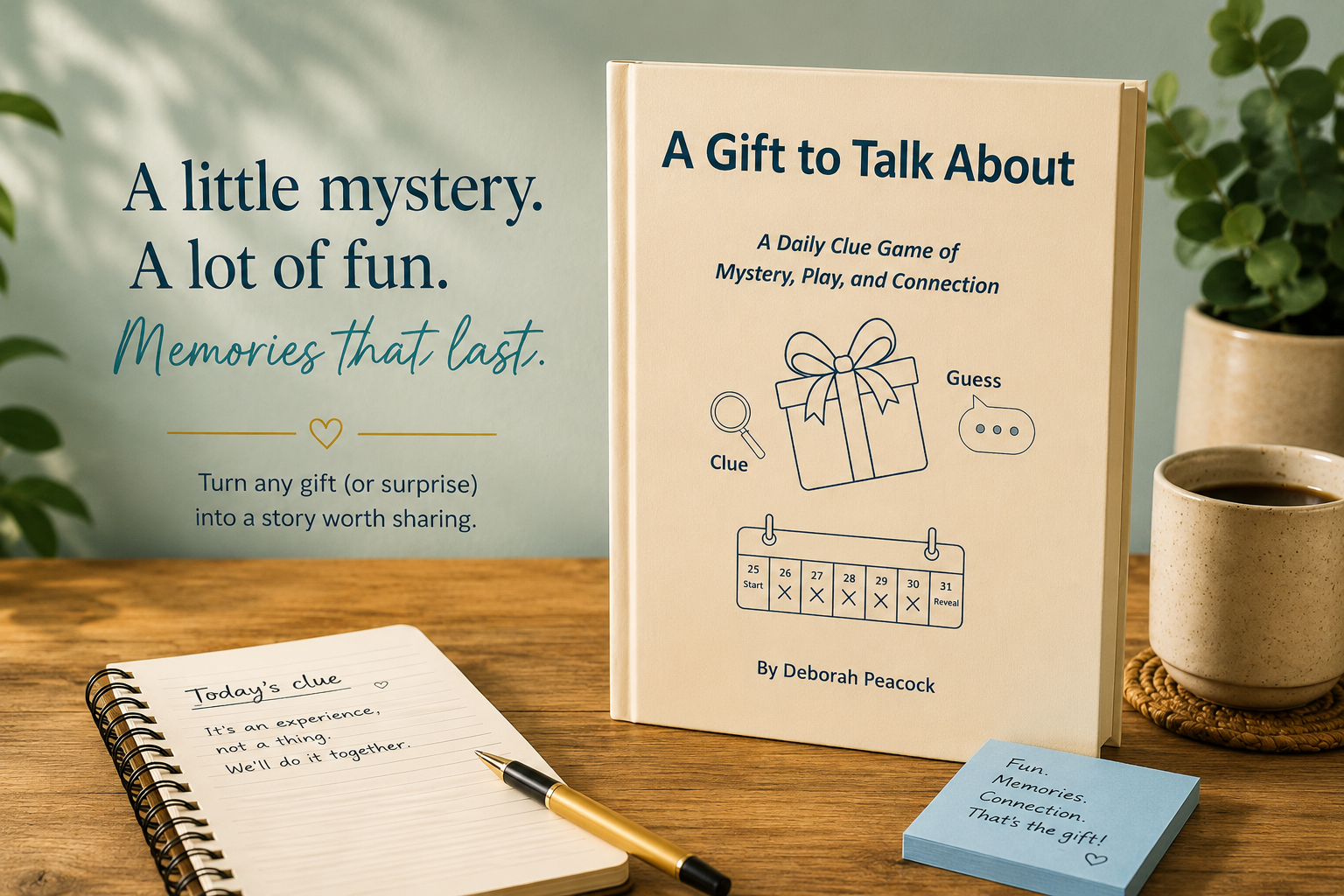
That experience reinforced something I had already built into A Gift to Talk About: the fun wasn’t tied to Christmas. It came from creating a mystery, revealing information a little at a time and giving people something to puzzle over and talk about together.
But that came later. Back at that first Christmas, I had already learned something I hadn’t expected when I picked up the phone on December 2 to order those passes.
A gift can be opened in a moment.
The mystery surrounding it can become part of the memory.
And perhaps the best indication that our accidental experiment had worked came afterward.
My family wanted to do it again.
All of them.
That changed things.
The first time, nobody had known there was going to be a game.
The next Christmas, they would be expecting one.
What had begun as a practical solution to a mailing problem had become a family tradition.
And that little group chat, created simply to keep a few envelopes out of the recycling bin, had become the inspiration for A Gift to Talk About.
The title turned out to be rather literal.
The gift really had given us something to talk about — long before anyone knew what it was.
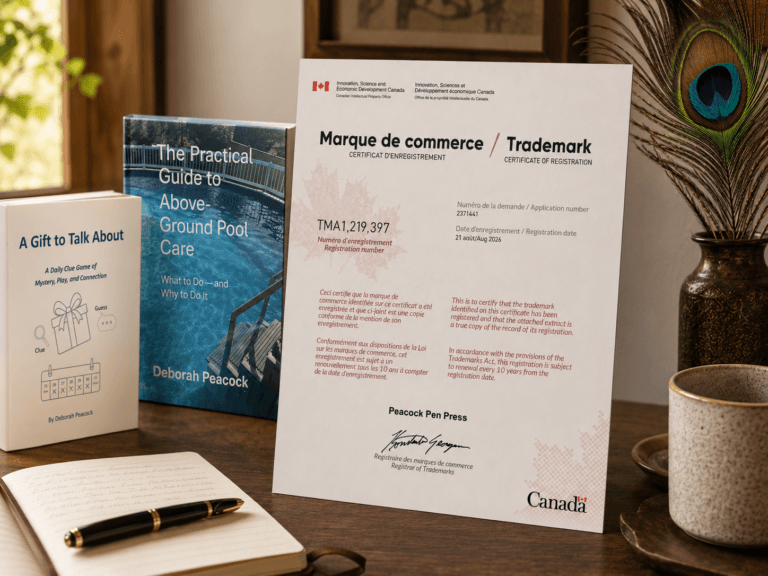
If you’d like to see how the idea developed into a complete game, you can find A Gift to Talk About on the Peacock Pen Press book page.
Which brings me back to Christmas in July.
Or, in my case, Christmas in July arriving in August.
Perhaps I’m not as late as I thought.
If you like the idea of turning an ordinary gift — or even a surprise or shared experience — into something people start talking about before the big reveal, the game can be adapted for almost any occasion. There is still plenty of time to create a mystery of your own.
After all, I didn’t discover the idea until December 2.
You’ve got a head start.
— Deb
Peacock Pen Press
Where Curiosity Meets Adventure