The Peacock Pen Press Trademark Journey
For much of my adult life, I had the idea somewhere in the back of my mind that I would like to be a published author. It was something I talked about more than once with a close friend, who always encouraged me to pursue it.
When my children were small, I occasionally dabbled in writing little storybooks for them for birthdays and other special occasions. I enjoyed doing it, but I never really thought of myself as someone who could become a published author.
I had a lot of self-doubt.
I did not think my understanding of story structure was strong enough, and I certainly did not consider the English side of my education one of my strengths. Writing a story for my own children was one thing. Writing something that strangers might actually pay to read seemed entirely different.
Years later, after I was already working as a registered nurse, I went back to school to upgrade my nursing diploma to an undergraduate degree.
I did not go back to school to learn how to become a writer, of course, but something unexpected happened along the way. University required an immense amount of reading as well as writing, and both taught me a great deal about how written work is put together.
The more I read, the more I absorbed about how ideas are developed, how information is organized and how one thought leads naturally into the next. Writing scholarly papers added another layer. They have an architecture of their own. You begin with a premise. You develop the argument or evidence in a logical way. And eventually you bring the reader back around to a conclusion.
There was a kind of arc to it.
It was not fiction, but I began to understand that good writing was not simply a matter of having the right words. There was a structure underneath those words that helped carry the reader from the beginning to the end.
When I later completed my master’s degree, I went a little further. I chose an elective in the arts division that focused on writing.
Somewhere through all of that, I began accumulating tools I had once assumed I did not have.
The dream of becoming a published author never completely disappeared. It simply waited while I worked, raised my family and got on with the rest of life.
Then I retired.
For the first time, I had both the time and the opportunity to take that old dream seriously.
Technology had changed as well. Writing no longer necessarily meant sitting at a keyboard and typing every word. Voice dictation and other tools made it much easier for me to get ideas out of my head and onto the page.
Gradually, what had always been a someday dream started becoming something I was actually doing.
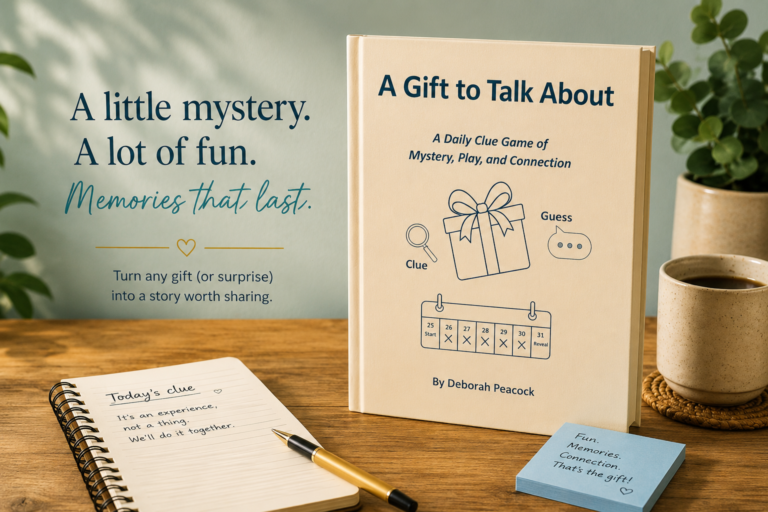
I began writing books. I built a website. I started learning about publishing through Amazon KDP, book design, marketing and a whole collection of things I had never imagined would be part of becoming an author. I taught myself to use GIMP so I could manipulate images and create book covers. My projects began to branch out too — from A Gift to Talk About and the Magic Colouring and Activity Book to my book about caring for our backyard pool, with still more books taking shape in the wings. Each project seemed to teach me something new.
Somewhere along the way, Peacock Pen Press was born.
At first, it was a name. Then it became the name on my books, my website and the growing collection of projects I was creating. The more I built around it, the more important the name became to me.
Eventually I started thinking about protecting it.
Registering a trademark seemed like the logical next step.
My original understanding of the process was probably something along the lines of this:
Choose the name.
Fill out an application.
Pay the fee.
Get the trademark.
Simple.
As I would discover, there were a few details missing from that plan.
I filed my application for Peacock Pen Press with the Canadian Intellectual Property Office (CIPO) on December 27, 2024.
Then I waited.
Trademark applications are not known for moving at lightning speed, so for quite a while there was very little to do except occasionally check the status and remind myself that no news did not necessarily mean bad news.
Eventually, though, there was news.
My application required changes.
That was the point when the process became considerably more interesting.
I was not a trademark lawyer. I had never filed a trademark application before, and the language used in government correspondence was not exactly casual reading.
I had a decision to make.
I could hire someone to deal with it for me, or I could try to understand what was being requested and see whether I could make the necessary revisions myself.
By then I had already invested money in the application. Walking away from it simply because the process had become more complicated did not make much sense to me.
So, I started researching.
I read.
I reread.
I tried to understand what CIPO was asking for and why.
I used the resources available to me, including artificial intelligence, to help me interpret terminology, organize information and work through possible revisions. I still had to make the decisions and submit the response, but the technology made navigating unfamiliar territory considerably less intimidating.
At the same time, something rather curious started happening.
Lawyers began finding me.
Once the trademark application and the request for revisions became part of the public record, I started receiving correspondence from legal firms offering to help.
The timing was interesting.
I was already working my way through the problem myself, but now I had professionals essentially appearing at the door to tell me that they could take over.
There was some reassurance in that.
If I could not resolve the issue myself, I still had time to seek professional help.
So, I kept going.
Eventually, I submitted the revisions.
Then came more waiting.
That might be one of the less glamorous parts of pursuing a trademark: a surprising amount of the journey consists of doing everything you can do and then doing absolutely nothing while someone somewhere works through the next stage.
Eventually, the application was accepted.
Then Peacock Pen Press was advertised in the Canadian Trademarks Journal.
That brought another waiting period.
Publication gave others an opportunity to oppose the registration. I knew there was a set period involved, so I watched the calendar and waited for that date to pass.
It did.
And then I waited some more.
By August 2026, the opposition period had ended, but the status still had not changed to registered.
I found myself checking periodically and wondering whether summer holidays might have slowed things down.
There was nothing left for me to submit.
Nothing left for me to correct.
Nothing left for me to argue.
The application had simply reached that strange stage in any long process where you know you are almost at the finish line but cannot quite see anyone waving the flag.
Then, on August 21, 2026, the email arrived.
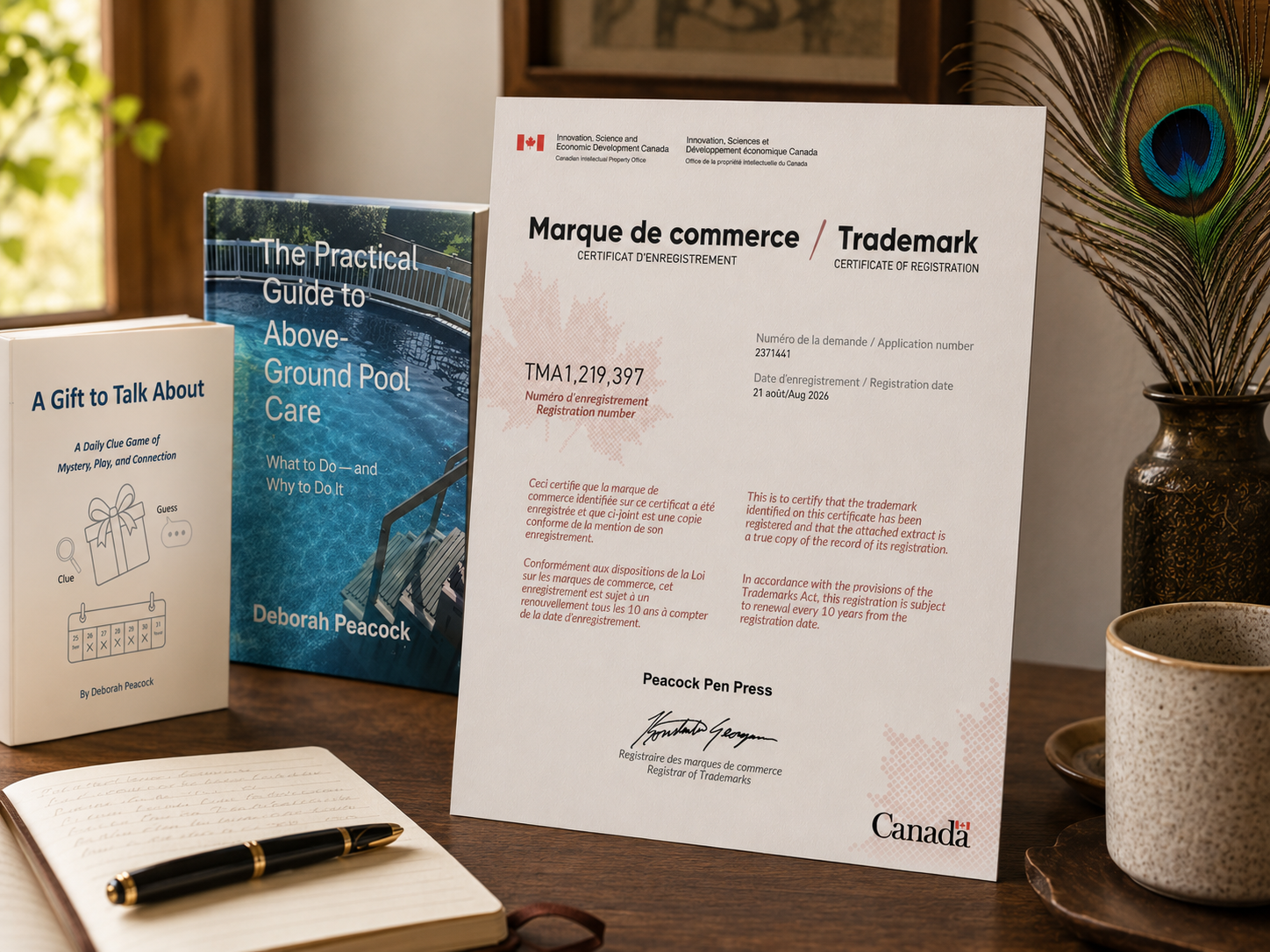
Attached to it was the Certificate of Registration for Peacock Pen Press.
I opened the attachment.
At the top were the words:
Trademark — Certificate of Registration.
And farther down the page:
Peacock Pen Press.
Officially registered.
I stared at it for a moment.
It was, after all, a government certificate confirming that an administrative process had been completed.
But it felt like much more than that.
Peacock Pen Press had begun as an idea attached to an old dream.
Retirement had finally given me time to pursue that dream. Technology had given me new ways to write. One project had led to another, and somewhere in the middle of all that experimenting, learning and creating, I had built something that mattered enough to me that I wanted to protect its name.
The trademark journey took longer than I expected.
It required patience.
It required research.
At times it required me to wade into subjects I knew almost nothing about and figure them out as I went.
That, I suppose, has been true of much of this publishing adventure.
I did not retire knowing how to become a publisher.
I did not know how to build websites, format books, navigate publishing platforms or apply for trademarks.
I simply kept learning the next thing I needed to know.
My husband was the first person I told. The next was the friend who had listened to me talk about becoming an author for years and had always encouraged me to keep going.
What had once been part of a someday dream had become something real enough to have its own registration number.
I rather like that.
Every ten years, according to the certificate, I will have to renew it.
I think I can live with that.
— Deb
Peacock Pen Press
Where Curiosity Meets Adventure